Best Company Data APIs in 2026: Benchmark-Backed Picks by Use Case
Best company data APIs compared by use case, benchmark coverage, data depth, LinkedIn coverage, raw datasets, AI agents, and enrichment workflows.
Summarize this blog post with
 ChatGPT
 Perplexity
 Claude
 Grok
Grok Google AI
The best company data APIs are not the same for every team. A RevOps team enriching CRM accounts needs a different provider than a data science team buying raw datasets, a product team embedding company profiles, or an AI-agent builder that needs clean JSON responses in real time.
Over the past few years building CompanyEnrich, I have watched the same pattern repeat. Buyers start by looking for the provider with the most data, then realize the better test is which provider returns the fields their workflow actually uses, at a cost model they can scale.
That distinction matters because company data is no longer just a spreadsheet problem. It now powers lead routing, account scoring, personalization, TAM analysis, market mapping, enrichment waterfalls, and AI agents. Gartner says poor data quality costs organizations at least $12.9 million per year on average, and the cost gets worse when bad data flows into automated systems.
So this is not another generic list of logos. It is a use-case guide backed by our public Company Enrichment API Benchmark, where we tested domain-based company enrichment APIs on the same 349 DNS-resolved domains.
What This Guide Covers
This guide compares the best company data APIs by actual use case. Inside, you will learn:
- Which company data APIs fit real-time enrichment, raw datasets, LinkedIn coverage, revenue data, job signals, and AI-agent workflows
- How CompanyEnrich, Apollo, People Data Labs, Crustdata, Coresignal, and ContactOut performed in our benchmark
- Where People Data Labs, Crustdata, Coresignal, and Apollo are still stronger choices than CompanyEnrich
- Why ZoomInfo, Clearbit, Clay, and Crunchbase are not ranked here
- Why benchmark data should be read by field, not just by overall ranking
- How to choose a company enrichment API for your own workflow
Watch: Which Company Data API Fits Your Workflow?
If you prefer a video walkthrough before reading the full comparison, I recorded a short breakdown of the main company data API workflows: CRM enrichment, raw datasets, LinkedIn coverage, revenue data, hiring signals, and AI agents.
The video covers CompanyEnrich, People Data Labs, Crustdata, Coresignal, and ContactOut, and explains how to match each provider to the workflow where it is strongest.
What Is a Company Data API?
A company data API is an endpoint that returns structured information about companies. Depending on the provider, that can include company name, domain, description, industry, employee count, revenue, location, phone, technologies, social profiles, funding, corporate relationships, hiring signals, and related accounts.
The category is broad. That is why "best" can get slippery fast.
Some APIs are built for real-time enrichment. You send a domain like stripe.com and get a company profile back. Others are built for raw datasets, where a data team licenses a large file or bulk feed and loads it into a warehouse. Others specialize in jobs, hiring signals, people data, or company-change monitoring.
Here is the simplest way to think about it:
| API type | What it does | Best for |
|---|---|---|
| Real-time company enrichment API | Turns a domain, name, or profile URL into a company record | CRM enrichment, product onboarding, lead routing, AI agents |
| Company search API | Finds companies that match filters or semantic descriptions | TAM building, prospecting, account discovery |
| Raw dataset feed | Delivers company or people data in bulk | Data lakes, ML training, warehouse enrichment |
| Jobs or hiring API | Returns job postings and hiring signals | Recruiting, investment research, GTM triggers |
What to do: Start by naming the workflow. "We need company data" is too broad. "We need to enrich 50,000 signup domains every month and send clean JSON to an AI agent" is specific enough to evaluate.
Why Most Best Company Data API Lists Are Misleading
Most company data API rankings make the same mistake: they rank providers as if they were interchangeable, and they are not. One provider may return the best LinkedIn URL coverage. Another may have the best raw dataset model. Another may be strongest on technologies, jobs, or corporate relations. Another may be the better real-time enrichment layer because it combines coverage, field depth, pricing, and API ergonomics.
Our benchmark made the difference obvious. In the 349-domain test, CompanyEnrich had the highest overall find rate and deepest returned profiles, but People Data Labs led LinkedIn URL coverage, ContactOut and Crustdata tied for revenue coverage, and People Data Labs led corporate relations. That is the useful version of the answer: not one winner for everything, but a field-by-field map.
When we first started publishing benchmark pages, I was a little nervous about showing fields where competitors beat us. But that is exactly what makes the benchmark useful. If a buyer only cares about Crunchbase links, they should know PDL did better there. If they care about broader real-time enrichment depth, they should see where CompanyEnrich led. A comparison page that hides tradeoffs is not a comparison page. It is an ad.
How We Evaluated the Best Company Data APIs
This guide uses three inputs:
- Our public company enrichment API benchmark
- Existing CompanyEnrich comparison pages for People Data Labs, Crustdata, and Coresignal
- Public documentation from providers, including People Data Labs, Crustdata, and Coresignal
The provider set covered in this article is the six providers in the benchmark:
- CompanyEnrich
- Apollo
- People Data Labs
- ContactOut
- Coresignal
- Crustdata
We started with 500 random domains from the Majestic Million. After DNS cleanup, 349 domains resolved and were used as the benchmark set.
The benchmark measured:
- Find rate: How often each provider returned usable company data
- Data depth: How many of 27 canonical fields appeared in returned profiles
- Field fill rate: How often each specific field was populated across all 349 submitted domains
- Category coverage: Core identity, firmographics, location/contact, socials, taxonomy, technologies, funding, and org structure
This benchmark is not a full manual accuracy audit. It measures coverage and field presence, not whether every returned value is correct. Before buying any provider, you should run a small test on your own target accounts.
Best Company Data APIs by Use Case
If you only read one table, make it this one.
| Use case | Best pick or picks | Why |
|---|---|---|
| Overall real-time company enrichment | CompanyEnrich | Highest find rate and highest average field depth in the benchmark |
| Raw datasets and bulk data | People Data Labs, Crustdata, Coresignal | Better fit when you need offline datasets, data lake workflows, jobs data, or large-scale raw company and person data access |
| LinkedIn URL coverage | People Data Labs | Highest LinkedIn URL fill rate, 60.2% vs CompanyEnrich at 55.6% |
| Revenue coverage | ContactOut, Crustdata | Both tied for revenue coverage in the benchmark |
| Social URL breadth | CompanyEnrich | Led Facebook, X/Twitter, Instagram, and YouTube coverage |
| Corporate relations | People Data Labs | Led parent, subsidiary, and affiliate-style corporate relation coverage |
| Technology and funding fields | Apollo, CompanyEnrich | Apollo led technologies at 61.0% and funding signals at 10.6%; CompanyEnrich was at 60.2% and 9.2%, gaps the benchmark calls not statistically distinguishable |
| Sales teams that want an app plus an API | Apollo | Second on find rate and profile depth, with prospecting, sequences, and CRM sync in one product |
| Jobs and hiring signals | Crustdata, Coresignal | Better fit when job postings or hiring changes are the main reason you are buying |
| AI-agent workflows | CompanyEnrich | MCP server, semantic search, clean API workflows, and no-cap positioning |
| Lookalike company discovery | CompanyEnrich | Dedicated Similar Companies API for expanding from seed accounts |
The important nuance: People Data Labs had the best LinkedIn URL coverage, but the gap was not huge. PDL returned LinkedIn URLs for 60.2% of submitted domains. CompanyEnrich returned them for 55.6%. That makes PDL the field-level winner, but not enough to choose PDL on LinkedIn alone unless that field is the primary requirement.
Bottom line: Choose by workflow first, benchmark field second, pricing model third. If all three point to the same vendor, you have a strong shortlist.
Best Company Data APIs: Shortlist for 2026
Below is the provider-by-provider view. I am intentionally keeping each profile use-case oriented instead of turning this into a feature dump.
1. CompanyEnrich: Best for Real-Time B2B Data Infrastructure and AI-Agent Workflows
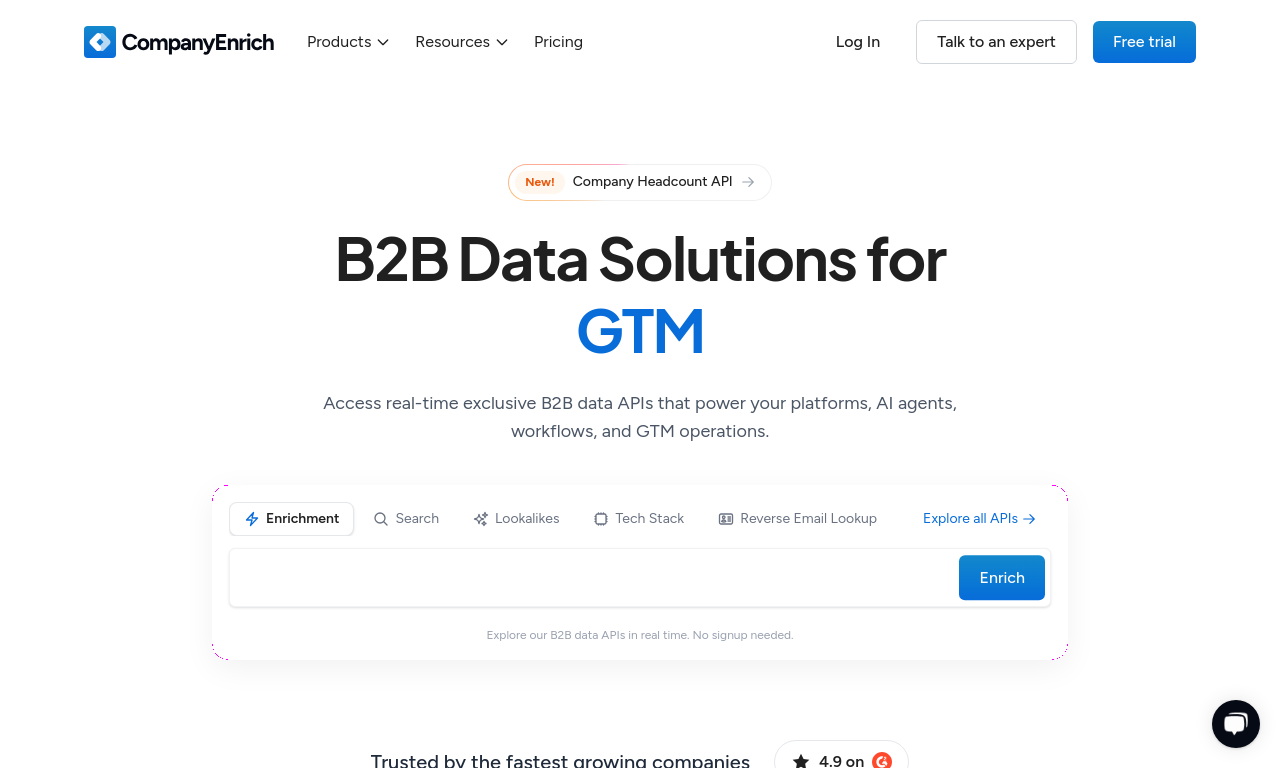
CompanyEnrich is B2B data infrastructure for real-time company enrichment, company search, people search, reverse email lookup, similar companies, workforce data, and AI-agent workflows.
In our benchmark, CompanyEnrich had the highest overall find rate and the deepest returned company profiles:
- 67.6% find rate
- 17.9 / 27 average fields per returned profile
- 19 / 27 median fields per returned profile
- 12.1 average data points per submitted domain
CompanyEnrich also led core identity, location/contact, social web, and taxonomy category averages. At field level, it led company name, logo, description, keywords, industry, location, phone, Facebook, X/Twitter, Instagram, and YouTube.
Why choose CompanyEnrich
Choose CompanyEnrich if you need a real-time B2B data layer that works inside production workflows. That could mean signup enrichment, CRM enrichment, account routing, scoring, product onboarding, AI agents, Clay workflows, or enrichment waterfalls.
CompanyEnrich is especially strong when the workflow needs:
- Real-time company enrichment from domain, name, website, or social profile
- Company search and semantic search
- Similar companies API for lookalike discovery
- Reverse email lookup and people search
- Workforce and headcount data
- MCP support for AI-agent workflows
- No-cap, cost-effective API access at scale
Integrations
CompanyEnrich connects into the workflows where GTM and data teams already operate. The public integrations page lists native or supported integrations with Clay, Cargo, Databar, n8n, Intercom, HubSpot, and other workflow tools. CompanyEnrich also has confirmed partner and integration motion with ColdIQ, Latenode, Composio, LoopGTM, and Signalbase.
That matters because company data is rarely useful in isolation. It needs to move into CRM fields, Clay tables, routing rules, enrichment waterfalls, warehouses, and agent workflows.
Who CompanyEnrich is for
CompanyEnrich is a strong fit for:
- RevOps teams enriching CRM accounts and routing inbound leads
- GTM engineers building enrichment waterfalls and account scoring systems
- AI-agent builders that need clean company data through APIs or MCP
- Founders and growth teams building account lists from semantic search or lookalikes
- Product teams embedding company profiles, firmographics, or account intelligence into their own product
- Data infrastructure teams that need real-time B2B company data without maintaining their own enrichment pipeline
Pros
- Highest overall find rate in the benchmark, 67.6%
- Deepest average returned profile, 17.9 / 27 benchmark fields
- Strong social URL breadth across Facebook, X/Twitter, Instagram, and YouTube
- API-first workflows for enrichment, search, lookalikes, people search, reverse email lookup, workforce data, and MCP
- No-cap positioning and waterfall-friendly usage for high-volume teams
Cons
- Not a bulk dataset vendor, so data lake and offline dataset buyers should also evaluate People Data Labs, Crustdata, and Coresignal
- Did not lead every field in the benchmark, including LinkedIn URL coverage, corporate relations, Crunchbase URL coverage, and revenue coverage
Where CompanyEnrich is not the best fit
CompanyEnrich is not trying to be a bulk dataset vendor. If your team needs offline company and people files delivered into a data lake, People Data Labs, Crustdata, or Coresignal may be a better fit.
It also did not win every benchmark field. People Data Labs led LinkedIn URL coverage, employee count, company type, Crunchbase URLs, and corporate relations. ContactOut and Crustdata tied on revenue.
That honesty matters. CompanyEnrich is the best default pick for real-time enrichment depth in this benchmark, not a universal answer for every data workflow.
2. People Data Labs: Best for Raw Datasets, LinkedIn Coverage, and Corporate Relations
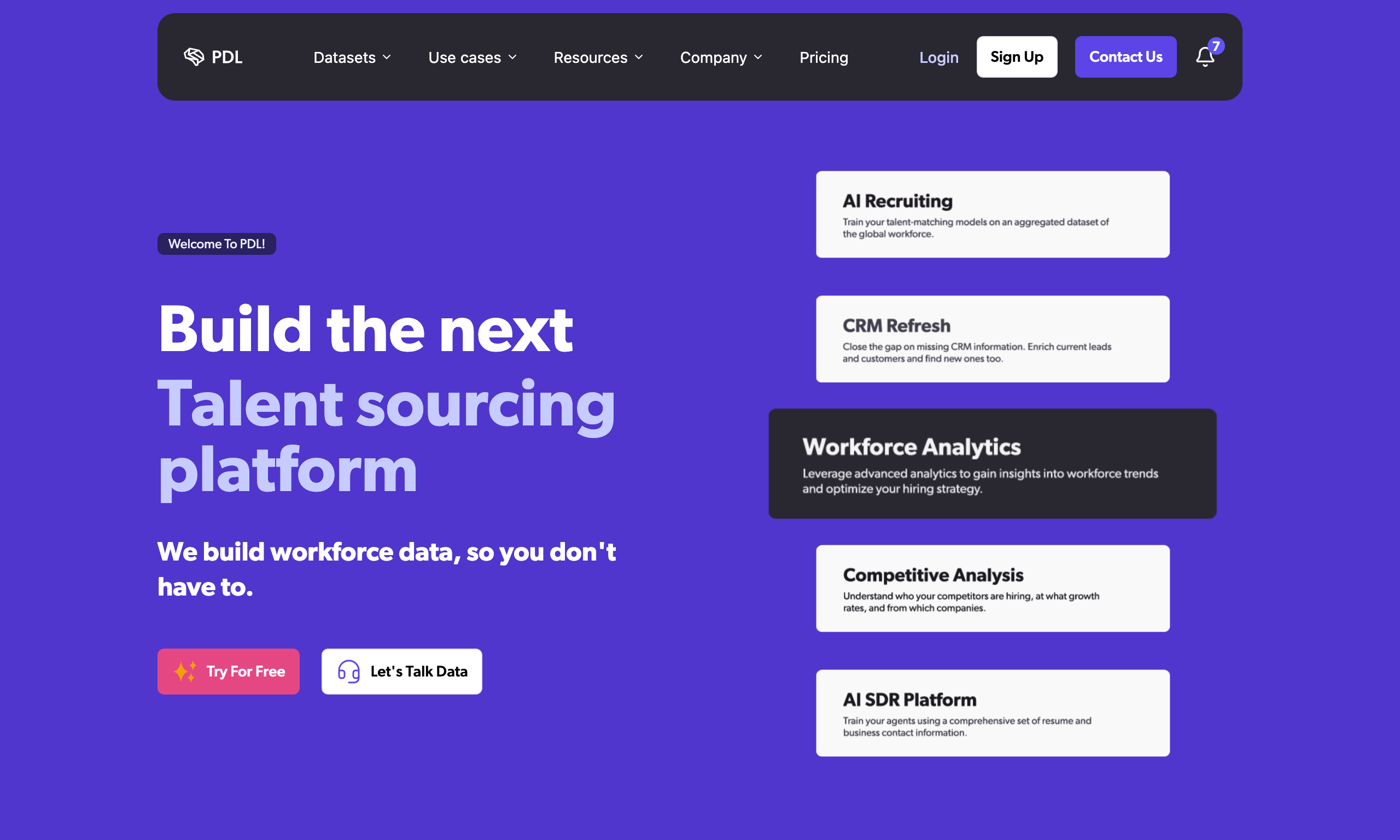
People Data Labs is an established B2B data provider with person data, company data, enrichment APIs, search APIs, and data license feeds.
In this category, PDL is strongest when the buyer wants bulk data access or offline data delivery. Its company data license feed covers global and country-level datasets delivered through cloud providers, Amazon Data Exchange, or FTP. That is a different buying motion from CompanyEnrich's real-time B2B data infrastructure.
Why choose People Data Labs
Choose PDL if your team needs:
- Raw datasets or offline data slices
- Data lake or ML training workflows
- Strong LinkedIn URL coverage
- Corporate relationship fields
- Person and company data access for offline workflows
In our benchmark, People Data Labs had the highest LinkedIn URL coverage at 60.2%, with CompanyEnrich close behind at 55.6%. PDL also led corporate relations at 10.6%, and led employee count and company type.
Where PDL is weaker in this benchmark
CompanyEnrich had the higher overall find rate, 67.6% vs PDL at 60.2%. CompanyEnrich also returned deeper profiles on average, 17.9 / 27 fields vs PDL at 13.7 / 27 fields.
Pros
- Strong fit for raw datasets, data lakes, ML workflows, and data science teams
- Best LinkedIn URL coverage in the benchmark, 60.2%
- Led corporate relations, employee count, company type, and Crunchbase URL coverage
- Established provider for person and company datasets
Cons
- Lower overall find rate than CompanyEnrich in the benchmark, 60.2% vs 67.6%
- Lower average returned profile depth, 13.7 / 27 vs CompanyEnrich at 17.9 / 27
- Less focused on real-time enrichment, semantic search, lookalikes, and AI-agent workflows
For the deeper head-to-head, read the People Data Labs vs CompanyEnrich comparison.
3. Crustdata: Best for Jobs, Hiring Signals, Watcher Workflows, and Some Revenue Coverage
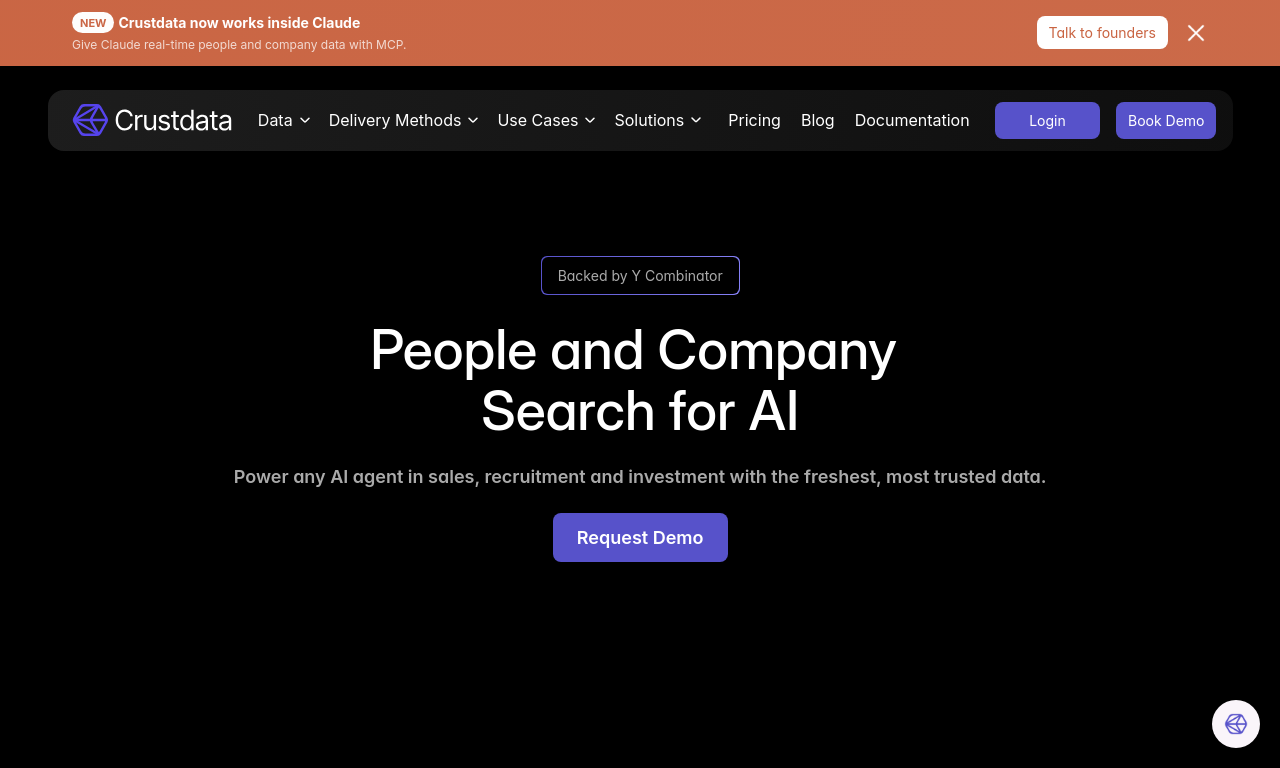
Crustdata is a strong fit when the workflow starts from company events, hiring signals, jobs, funding signals, or change monitoring.
Crustdata's Watcher API is built around subscribing to updates about companies or people and receiving webhook notifications. Its docs also include job search workflows for finding and segmenting job listings across its job dataset.
That makes Crustdata more event and dataset oriented than a pure real-time company enrichment API.
Why choose Crustdata
Choose Crustdata if your team needs:
- Job listings
- Hiring signals
- Watcher API workflows
- Dataset-style access
- Revenue coverage
- Crunchbase and follower count signals
In our benchmark, Crustdata tied ContactOut for revenue coverage at 45.6%. It also returned meaningful Crunchbase URL coverage, X/Twitter coverage, follower count coverage, and limited funding signals.
Where Crustdata is weaker in this benchmark
CompanyEnrich had a 67.6% find rate vs Crustdata at 50.1%. CompanyEnrich also averaged 17.9 / 27 fields per returned profile vs Crustdata at 13.0 / 27.
Pros
- Strong fit for jobs, hiring signals, Watcher API workflows, and datasets
- Tied ContactOut for revenue coverage in the benchmark, 45.6%
- Returned meaningful Crunchbase, follower count, X/Twitter, and limited funding signals
- Better fit than CompanyEnrich when company-change monitoring is the main requirement
Cons
- Lower find rate than CompanyEnrich in the benchmark, 50.1% vs 67.6%
- Lower average returned profile depth, 13.0 / 27 vs CompanyEnrich at 17.9 / 27
- Less focused on real-time enrichment, taxonomy, technologies, social breadth, lookalikes, and AI-agent data access
For more detail, read the Crustdata vs CompanyEnrich comparison.
4. Coresignal: Best for Jobs API and Dataset-Oriented Teams
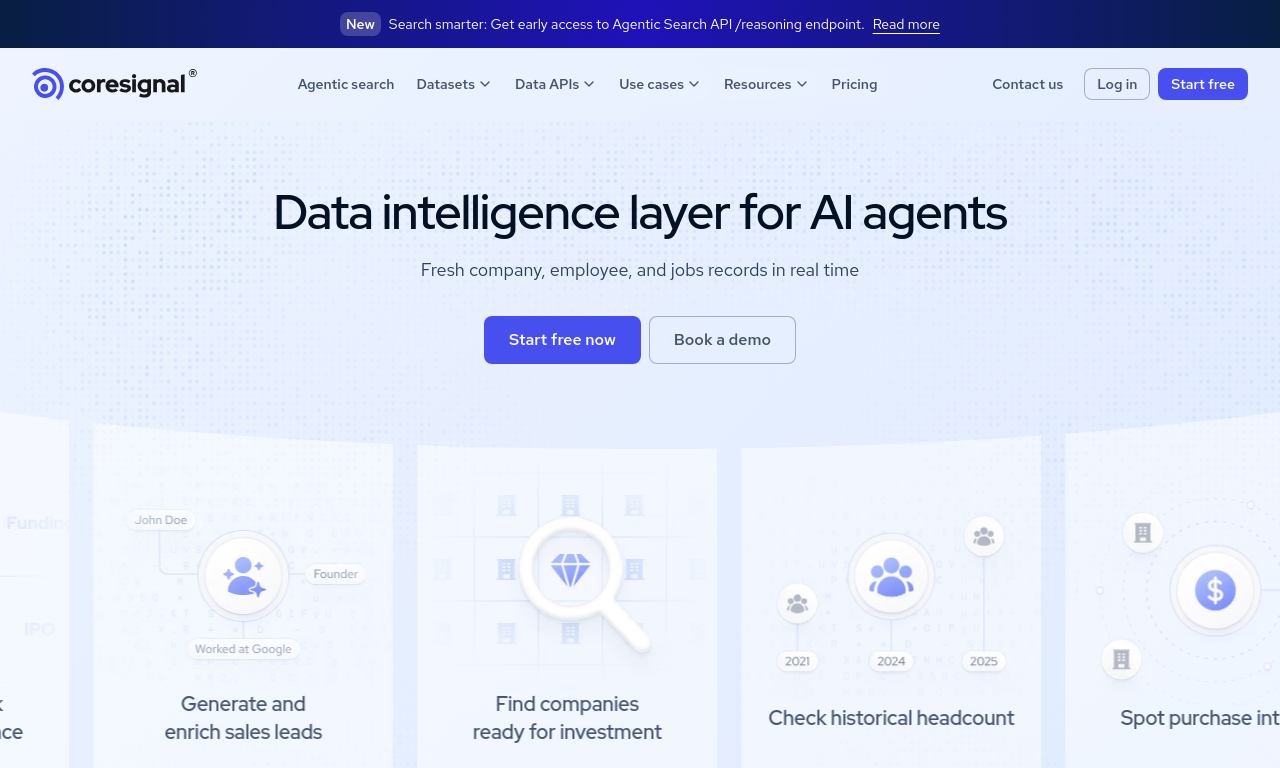
Coresignal is a public web data provider with company, employee, and jobs data available through datasets and APIs. Its docs describe company APIs, employee APIs, jobs APIs, datasets, and bulk collection flows.
That makes Coresignal a strong fit for data teams that need dataset access, jobs data, or public web data at scale.
Why choose Coresignal
Choose Coresignal if your team needs:
- Jobs API workflows
- Offline datasets
- Employee and company data from public web sources
- Data team workflows rather than GTM operator workflows
In the benchmark, Coresignal had lower coverage than CompanyEnrich, People Data Labs, and ContactOut. But its matched profiles were not shallow. It averaged 14.2 / 27 fields per returned profile, which put it above People Data Labs, ContactOut, and Crustdata on matched profile depth.
Where Coresignal is weaker in this benchmark
CompanyEnrich had a higher find rate, 67.6% vs Coresignal at 50.4%. CompanyEnrich also led on social coverage, technology fields, location coverage, phone coverage, and overall returned profile depth.
Pros
- Strong fit for Jobs API workflows and offline datasets
- Useful for data teams that want employee and company data from public web sources
- Matched profiles were relatively deep at 14.2 / 27 fields on average
- Better fit than CompanyEnrich when jobs data or dataset delivery is the primary buying reason
Cons
- Lower find rate than CompanyEnrich in the benchmark, 50.4% vs 67.6%
- Lower average returned profile depth, 14.2 / 27 vs CompanyEnrich at 17.9 / 27
- Weaker in this benchmark on social coverage, technology fields, location coverage, and phone coverage
For the deeper comparison, read Coresignal vs CompanyEnrich.
5. ContactOut: Best for Follower Count and Specific Revenue Coverage
ContactOut is usually known more for contact data than company enrichment. In our company enrichment benchmark, it had a narrower profile than the broadest providers, but it did lead in a few useful places.
ContactOut tied Crustdata for revenue coverage at 45.6%. It also led follower count coverage at 51.6%.
Why choose ContactOut
Choose ContactOut if your use case depends heavily on:
- Contact data workflows
- Follower count
- Revenue field coverage
Where ContactOut is weaker in this benchmark
ContactOut had a 53.0% find rate and averaged 11.5 / 27 fields per returned profile. It also left several tracked fields unpopulated in the tested response, including technologies, phone, Facebook, X/Twitter, Instagram, YouTube, and broader social URL coverage.
Pros
- Led follower count coverage in the benchmark, 51.6%
- Tied Crustdata for revenue coverage, 45.6%
- Can make sense when contact-data workflows are the primary requirement
Cons
- Lower find rate than CompanyEnrich in the benchmark, 53.0% vs 67.6%
- Lowest average returned profile depth among the providers covered here, 11.5 / 27
- Technologies, phone, Facebook, X/Twitter, Instagram, YouTube, and broader social URL coverage were unpopulated in the tested response
For narrow use cases, ContactOut may still make sense. For broad company enrichment, it was not the strongest option in this benchmark.
6. Apollo: Best for Sales Teams That Want an App With an API, and for Technology and Funding Fields
Apollo is a sales platform with a data API attached, not an API-first data provider. It is on this list because it was in the benchmark and finished second: a 61.6% find rate, 215 of 349 domains, behind CompanyEnrich at 67.6% and ahead of People Data Labs at 60.2%.
Apollo also returned the second-deepest profiles, 15.4 / 27 fields on average and a median of 16 / 27, and it led three fields outright: technologies at 61.0%, founded year at 43.6%, and the merged funding signal at 10.6%.
Why choose Apollo
Choose Apollo if your team needs:
- Prospecting, sequences, a dialer, and CRM sync in the same product as the data
- Technology fields, where it led at 61.0% against CompanyEnrich at 60.2%
- Funding signals, where it led at 10.6% through its funding events array, against CompanyEnrich at 9.2%
- A second source in an enrichment waterfall, since it matched 215 domains with a broad field profile
The benchmark page notes that the technology and funding leads are within five records of CompanyEnrich, which it calls not statistically distinguishable at this sample size. Treat them as a tie, not as a reason to pick Apollo on those fields alone.
Where Apollo is weaker in this benchmark
CompanyEnrich had the higher find rate, 67.6% vs 61.6%, and deeper profiles, 17.9 / 27 vs 15.4 / 27. Apollo returned no company type, Instagram, YouTube, Crunchbase URL, or follower count in the tested response, and its social category average was 20.2% against CompanyEnrich at 34.5%.
The bigger difference is packaging. API enrichment is included on paid plans, but Apollo's pricing page places broader API access on custom plans, and the product is sold by seat for sales users rather than per call. Teams buying enrichment as infrastructure should model that cost before committing.
Pros
- Second on find rate, 61.6%, and on average profile depth, 15.4 / 27
- Led technologies, 61.0%, founded year, 43.6%, and funding signals, 10.6%
- Sales workflows and data in one product, plus an official MCP server
- Free plan, which is enough for a small test before buying
Cons
- Lower find rate and profile depth than CompanyEnrich, 61.6% vs 67.6% and 15.4 / 27 vs 17.9 / 27
- Company type, Instagram, YouTube, Crunchbase URL, and follower count were unpopulated in the tested response
- Sold by seat for sales users, with broader API access on custom plans
- No dataset delivery for bulk or offline workflows
Apollo is the right pick when the sales team is the buyer, and a reasonable fallback source in a waterfall. It is not API-first infrastructure, which is why this guide treats it as a sales-team pick rather than a default enrichment layer.
Why ZoomInfo, Clearbit, Clay, and Crunchbase Are Not Ranked Here
Four names appear on most lists of company data APIs and are missing from this one. Each is missing for a reason you can check, and the first reason is shared: none of the four was in the benchmark, so there are no find rate or field numbers to rank them on.
- ZoomInfo does not publish API pricing. Its API documentation splits users into enterprise customers and self-serve customers, treats every call as a production request that consumes credits based on your account, and tells you to contact your account manager to learn which access points you are entitled to. There was no self-serve API to test on equal terms with the six providers above.
- Clearbit is no longer sold on its own. HubSpot acquired it in late 2023 and folded it into Breeze Intelligence, which only works inside HubSpot. Standalone Clearbit stopped taking new subscriptions, and its free tools were discontinued on April 30, 2025.
- Clay is not a data provider. It is an orchestration platform that pulls data from other providers, including several on this list, so it is where you would run one of these APIs, not a substitute for one.
- Crunchbase is a funding and investor database, and its API documentation states that access to the full API requires an Enterprise or Applications license. In this guide Crunchbase shows up as a field, not a provider: People Data Labs returned a Crunchbase URL for 38.1% of domains and Crustdata for 35.2%.
Which Company Data API Performed Best in the Benchmark?
Here is the benchmark summary at the highest level.
| Provider | Find rate | Avg fields per returned profile | Strongest signals in this benchmark |
|---|---|---|---|
| CompanyEnrich | 67.6% | 17.9 / 27 | Overall coverage, profile depth, identity, location/contact, social breadth, taxonomy |
| Apollo | 61.6% | 15.4 / 27 | Technologies, founded year, funding signals; strongest broad runner-up |
| People Data Labs | 60.2% | 13.7 / 27 | LinkedIn, employees, company type, Crunchbase, corporate relations |
| ContactOut | 53.0% | 11.5 / 27 | Follower count, revenue coverage |
| Coresignal | 50.4% | 14.2 / 27 | Jobs/data-team fit, relatively deep matched profiles |
| Crustdata | 50.1% | 13.0 / 27 | Revenue, Crunchbase, follower count, hiring-signal workflows |
CompanyEnrich had the best overall benchmark result for live domain enrichment. But field-level winners matter.
| Field or category | Benchmark leader | Notes |
|---|---|---|
| LinkedIn URL | People Data Labs | 60.2% vs CompanyEnrich at 55.6% |
| Revenue | ContactOut and Crustdata | Both at 45.6% |
| Employees | People Data Labs | 60.2% |
| Company type | People Data Labs | 60.2% |
| Technologies | Apollo | 61.0% vs CompanyEnrich at 60.2% |
| Founded year | Apollo | 43.6% vs CompanyEnrich at 43.3% |
| Funding signals | Apollo | 10.6% vs CompanyEnrich at 9.2%, a five-record gap |
| CompanyEnrich | 58.2% | |
| X/Twitter | CompanyEnrich | 52.4% |
| CompanyEnrich | 38.7% | |
| YouTube | CompanyEnrich | 29.5% |
| Corporate relations | People Data Labs | 10.6% |
The lesson is not "ignore all field winners and pick the highest average." The lesson is to map the fields to your workflow.
If your workflow only needs a LinkedIn URL, PDL looks strong. If it needs identity, description, industry, location, phone, multiple social URLs, taxonomy, and technologies, the overall profile becomes more important than any single field.
How Should You Choose the Best Company Data API?
Here is the decision framework I would use before signing with any provider.
1. Define the workflow before the vendor list
Write down the actual job.
Bad: "We need company data."
Better: "We need to enrich 25,000 new signup domains every month, return company name, industry, employee count, technologies, LinkedIn, phone, country, and description, then pass the JSON into our routing model."
Once you write it that way, the vendor list gets smaller.
2. Separate real-time enrichment from raw datasets
Real-time enrichment and raw datasets are different products.
If you need production API calls at the moment a signup, lead, or agent request happens, choose a real-time company enrichment API. If you need to load millions of records into a warehouse and build your own entity resolution layer, raw dataset providers like People Data Labs, Crustdata, and Coresignal may be a better fit.
What to do: Do not buy a dataset if your team really needs an API. Do not buy an API if your data team really needs a licensed bulk feed.
3. Test on your own domains
A benchmark gives direction. Your own account list gives the buying answer.
Before choosing any provider, test 100-500 domains from your real ICP. Include customers, open opportunities, small companies, international accounts, recently funded companies, and messy domains from your CRM.
Measure:
- Find rate
- Match correctness
- Required field coverage
- Response consistency
- Cost per usable record
- API latency
- Retry and failure behavior
4. Score by required fields, not total fields
Total field count is useful, but it can mislead.
If your routing workflow needs country, employee count, industry, and technology tags, then follower count and Crunchbase URLs may not matter. If your market intelligence workflow needs Crunchbase and corporate relationships, then PDL's strengths become more important.
Build a weighted field score:
| Field | Required? | Weight |
|---|---|---|
| Company name | Yes | 5 |
| Domain | Yes | 5 |
| Industry | Yes | 4 |
| Employee count | Yes | 4 |
| Technologies | Yes | 4 |
| LinkedIn URL | Useful | 3 |
| Revenue | Useful | 3 |
| Corporate relations | Optional | 1 |
Then score each provider against that model.
5. Check pricing under production volume
Company data pricing can look reasonable in a spreadsheet and become painful at production scale.
Ask:
- Is pricing per record, per credit, per endpoint, per seat, or contract-based?
- Are fields gated by plan?
- Are there rate limits?
- Are there result caps?
- Are failed or empty responses charged?
- Is bulk enrichment priced differently?
- Can you preview coverage before spending credits?
CompanyEnrich's positioning here is simple: no caps, every field available, and cost-effective usage at scale. But you should still model cost with your actual monthly volume.
6. Decide whether AI agents are part of the workflow
The company data API category is changing because AI agents need structured B2B data to make decisions. Salesforce's State of Sales research connects AI adoption with data quality, productivity, and personalization. The same pattern shows up in enrichment: bad input data makes agents look worse than they are.
If AI agents are part of the workflow, evaluate:
- Clean JSON responses
- Stable API schemas
- Low-latency lookups
- Semantic search
- MCP support
- Rate limits and caps
- Waterfall compatibility
This is where CompanyEnrich is intentionally focused. A no-cap API and MCP server matter when agents are making repeated enrichment, search, and lookup calls.
How Do Pricing, Caps, and Limits Change the Decision?
Benchmarks show coverage and depth. They do not show the whole buying picture.
Pricing and caps often decide the long-term fit.
Here is the practical way to model it:
| Question | Why it matters |
|---|---|
| What is the cost per usable enriched record? | A cheap lookup is not cheap if it often returns empty data |
| Are fields gated by plan? | Locked fields can break workflows after launch |
| Are there result caps? | Caps make bulk enrichment and agent workflows harder |
| Are there rate limits? | Agents and waterfalls can hit limits quickly |
| Can the API sit inside a waterfall? | Fallback logic improves real-world coverage |
| Can you preview coverage? | Previewing saves money before full enrichment runs |
Based on the current CompanyEnrich comparison pages, CompanyEnrich starts at $0.01 per credit. The PDL comparison page references PDL starting at $0.10 per credit, the Crustdata page references Crustdata starting at about $0.30 per credit, and the Coresignal page references Coresignal at about $0.20 per credit on the plan details provided for those comparisons. Apollo is priced per seat, starting at $49 per seat per month billed annually with a free plan, as recorded in our People Data Labs alternatives guide.
Pricing changes. Verify it before publishing or buying.
The broader point is stable: do not compare only the sticker price. Compare the cost per usable record after coverage, required fields, failures, retries, and integration time.
What This Benchmark Does Not Prove
The benchmark is useful, but it has boundaries.
It does not prove that every returned value is accurate. It measured whether data was returned and which fields were populated. A field can be present and still be stale, incomplete, formatted differently, or attached to the wrong entity.
It also tested domain-based company enrichment, not every endpoint every provider offers. Some providers may expose additional data through separate endpoints for people, jobs, datasets, funding, or account intelligence.
The sample matters too. The test used 349 DNS-resolved domains from a random Majestic Million sample. Results can change with another region, company size, industry, domain type, or ICP.
What to do: Treat the benchmark as a shortlist filter. Then run your own accuracy and fit test before production.
Final Recommendation: Which Company Data API Should You Pick?
If you need the best default choice for real-time company enrichment, CompanyEnrich is the strongest pick from our benchmark. It had the highest find rate, the deepest average profiles, and strong coverage across identity, location/contact, social breadth, taxonomy, and many practical GTM fields.
If you need raw datasets, People Data Labs, Crustdata, and Coresignal deserve serious evaluation. If you need LinkedIn URL coverage specifically, People Data Labs led that field, though CompanyEnrich was not far behind. If you need jobs and hiring signals, Crustdata or Coresignal may be the better fit. If a sales team is the buyer and wants an app as well as an API, Apollo finished second on find rate and profile depth.
The best buying process is simple:
- Define the workflow.
- Pick the required fields.
- Test 100-500 real domains.
- Measure usable record cost.
- Choose the API that fits the workflow, not the one with the most impressive homepage.
Company data is infrastructure now. Treat the buying process like infrastructure.
FAQ
What is the best company data API in 2026?
The best company data API depends on the workflow. In CompanyEnrich's public benchmark, CompanyEnrich had the highest overall find rate and deepest returned company profiles, making it the strongest default pick for real-time company enrichment. People Data Labs, Crustdata, and Coresignal are stronger fits for raw datasets and bulk data workflows. Apollo finished second on find rate and fits sales teams that want data and outreach in one product.
Which company data API has the best benchmark coverage?
In the CompanyEnrich benchmark, CompanyEnrich had the highest find rate at 67.6% across 349 DNS-resolved domains. Apollo reached 61.6%, People Data Labs reached 60.2%, ContactOut reached 53.0%, Coresignal reached 50.4%, and Crustdata reached 50.1%. The benchmark measured coverage and field depth, not full manual accuracy.
Which company data API is best for LinkedIn coverage?
People Data Labs had the best LinkedIn URL coverage in the benchmark, returning LinkedIn URLs for 60.2% of submitted domains. CompanyEnrich was close at 55.6%. That makes PDL the field-level winner for LinkedIn URL coverage, but the gap is not large enough to choose PDL on LinkedIn alone unless that field is central to your workflow.
Which company data APIs are best for raw datasets and bulk data?
People Data Labs, Crustdata, and Coresignal are the strongest fits for raw datasets and bulk data. They are better suited when you need offline datasets, data lake workflows, jobs data, employee data, or large-scale company and person data access. CompanyEnrich is more focused on real-time enrichment, search, lookalikes, reverse email lookup, and AI-agent-ready API workflows.
What is the best company data API for AI agents?
CompanyEnrich is the strongest fit for AI-agent workflows when the agent needs real-time company enrichment, company search, lookalike discovery, reverse email lookup, and clean API responses. CompanyEnrich also supports MCP, which makes it easier to connect enrichment and search workflows to MCP-compatible agent clients. For dataset-heavy AI workflows, evaluate People Data Labs, Crustdata, and Coresignal as well.
Should I use one company data API or a waterfall setup?
Use one provider if your required fields are covered reliably and your volume is predictable. Use a waterfall setup if coverage gaps create real business cost, such as missed routing decisions, incomplete lead scores, or empty enrichment results. CompanyEnrich is designed to work as a primary or fallback enrichment layer inside waterfall workflows.
How should I benchmark company data APIs before buying?
Benchmark company data APIs with 100-500 real domains from your own ICP. Measure find rate, match accuracy, required field coverage, latency, empty responses, pricing, and cost per usable record. Do not rely only on vendor claims or generic coverage numbers because your ICP, geography, and field requirements may produce different results.
Why are ZoomInfo, Clearbit, Clay, and Crunchbase not ranked here?
None of the four was in the benchmark, so there are no coverage numbers to rank them on. ZoomInfo does not publish API pricing and sets API entitlements per account. Clearbit is now part of HubSpot's Breeze Intelligence and is not sold standalone. Clay is an orchestration platform that pulls data from providers like the ones on this list. Crunchbase is a funding database whose full API requires an Enterprise or Applications license, and it appears in this guide as a field that People Data Labs and Crustdata return.
What is the difference between a company data API and a company enrichment API?
A company data API is the broad category for accessing structured company data through an API. A company enrichment API is a specific type of company data API that takes an input, such as a domain or company name, and returns a richer company profile. Some company data APIs also support search, datasets, jobs, funding, people data, reverse email lookup, or lookalike discovery.


Written by Amir, co-founder and CEO of CompanyEnrich. He has 10+ years of experience in B2B SaaS and data infrastructure, and previously founded and exited two B2B SaaS startups before starting CompanyEnrich. He now helps enterprises and startups integrate B2B intelligence into AI agents, workflows, and GTM operations.
Connect on LinkedIn