7 Best Lookalike Company APIs: Accuracy, Speed, and Pricing
Compare the best lookalike company APIs using independent tests on 48 seed companies. See relevance at 10 and 100 results, inputs, speed, and pricing.
Summarize this blog post with
 ChatGPT
 Perplexity
 Claude
 Grok
 Google AI
Every provider on a list of the best lookalike company APIs returns companies. The differences appear when you check them: how many actually resemble the seed, whether quality holds past the first ten rows, what the API accepts as input, and whether its license lets you use the results the way you plan to.
Lookalike lists feed very different jobs. A sales team expands from its best customers. A product team shows similar companies on a profile page. An AI agent turns one domain into a market map, then finds the decision-makers at each account. Each job needs its own mix of relevance, depth, filters, and speed.
This guide compares seven lookalike company APIs using provider documentation and independent results from Openbenchmarks, which tested ten providers on the same 48 seed companies. It explains:
- Which lookalike API fits each workflow
- How relevance changes between the first 10 and the first 100 results
- Where web search APIs such as Exa, Parallel, and Seltz fit
- How pricing models change what each usable company costs
Disclosure: CompanyEnrich publishes this guide and is one of the tested providers. Openbenchmarks Labs ran the measurements and describes its work as independent; we did not rerun them. Our lookalike benchmark analysis covers the method and its limits.
Which Lookalike Company API Is Best?
There isn't one best lookalike company API. The right choice depends on what uses the list: a person reviewing the first few results, a sequence or ad audience that takes all of them, an app that has to answer while someone waits, or an agent built on a web search API. Openbenchmarks gives the same advice: "Start from what consumes the list, not from the top of a ranking." Each recommendation below is based on the measurement that matters for that job.
| Workflow | Recommended API | Measured evidence |
|---|---|---|
| Best API for a short list of close matches | CompanyEnrich | 91.9% Precision@10 |
| Best API for long lists that feed sequences, ads, or pipelines | CompanyEnrich | 73.5% Precision@100 |
| Best API for real-time lookups | PredictLeads | 0.7 s average response, the fastest above 80% Precision@10 |
| Best web search API for finding similar companies | Seltz | 84.4% Precision@10 and 63.4% Precision@100 from a written query |
A few notes on the table:
- Speed only matters among providers whose top ten is worth showing, so it is compared across the four above 80% Precision@10. CUFinder answered faster (0.4 s) but scored 38.9%.
- PredictLeads returned up to 25 results per request in the test, against up to 100 for CompanyEnrich at 1.3 s. It also had the best or tied-best top 10 on 40 of the 48 seeds. Its public terms bar redistribution, so confirm an agreement before showing its results to customers.
- Cost isn't part of the measured results. The pricing section compares what each relevant company costs.
For the seven lookalike APIs reviewed below, here is when I would choose each one and where it falls short:
| Provider | When I would choose it | Where it falls short |
|---|---|---|
| CompanyEnrich | Relevant lists at depth, with filters, several seeds, and full profiles | Costs more per company than Extruct, Discolike, or ZoomInfo |
| PredictLeads | A short, explainable list of the closest matches | No relevant top 10 for 4 seeds, including Wise and Plaid |
| Extruct | Long internal research lists at a low price per search | Relevance falls to 61.1% across 100 results |
| Ocean.io | Internal prospecting that combines seeds with detailed filters | No relevant top 10 for 4 seeds, including OpenAI, and nothing for Faire |
| ZoomInfo | Free lookalikes for internal prospecting, if you already use ZoomInfo | Results have no domain, so usable records often cost data credits |
| Discolike | Experiments with seed domains, negative seeds, and ICP text together | About a third of its first 100 results judged relevant |
| CUFinder | A quick list from a domain, name, or LinkedIn URL, with contacts | Under 4 in 10 of its top results judged relevant |
Relevance and speed figures come from the Openbenchmarks October 16, 2026 update. Product capabilities, prices, and terms come from each provider's documentation, checked on October 28, 2026.
What Does a Lookalike Company API Do?
A lookalike company API takes one or more seed companies, usually as domains, and returns a ranked list of companies that resemble them. Good matching compares what a business sells, who buys from it, and how it operates. A shared industry code alone is too broad: two "software" companies can sell to completely different buyers.
Common workflows include:
- Customer lookalikes: start from your best customers and find similar accounts for outbound or account-based marketing.
- Competitor discovery: turn one company into a shortlist of direct and adjacent competitors. Our guide to finding competitors covers the qualification step.
- In-app recommendations: show a "similar companies" panel on a company profile inside your product.
- Market sizing: expand representative seeds into a target segment for a TAM estimate.
- People at lookalike accounts: pass the accepted domains to a people search API to find decision-makers, candidates, or founders.
Two things are often confused with lookalike APIs. Ad platforms build lookalike audiences of people inside their own networks; they don't return company records you can store. Web search APIs can find companies matching a written description, but they don't start from a seed domain. That difference matters for agents, as the benchmark shows.
How Do Lookalike Company APIs Compare in Independent Testing?
Openbenchmarks gave every provider the same 48 seed companies across 12 categories, from Procore and HubSpot to Caterpillar and Marriott. Each provider was asked for up to 100 similar companies using the input its interface accepts. A panel of three AI models from different labs then judged every returned company. A result counted as relevant only if the majority agreed it runs the same kind of business for the same kind of buyer and shares at least one product or service capability with the seed.
Two scores came out of that test:
- Precision@10: the share of the first 10 results judged relevant. It matters when a person reviews a shortlist or an app shows a few similar companies.
- Precision@100: the share of the first 100 positions filled with relevant companies. It matters when a sequence, ad audience, or data pipeline consumes the whole list. Empty positions count as misses.
| Provider | Seed input tested | Precision@10 | Precision@100 | Avg. response time |
|---|---|---|---|---|
| CompanyEnrich | Domain | 91.9% | 73.5% | 1.3 s |
| PredictLeads | Domain | 89.8% | Not ranked (25 results) | 0.7 s |
| Seltz | Written query | 84.4% | 63.4% | 4.8 s |
| Exa | Written query | 80.8% | 48.6% | 3.0 s |
| Extruct | Domain | 75.0% | 61.1% | 2.4 s |
| Ocean.io | Domain | 74.3% | 59.5% | 2.4 s |
| Parallel | Written query | 69.2% | 56.9% | 2.7 s |
| ZoomInfo | Company name | 67.1% | Not ranked (25 results) | 1.2 s |
| Discolike | Domain | 41.9% | 34.6% | 1.2 s |
| CUFinder | Domain | 38.9% | Not ranked (10 results) | 0.4 s |
Source: Openbenchmarks lookalike benchmark and its public results API. Response time is the publisher's mean per-request latency. Providers that returned 10 or 25 results did less work per request, and not every provider was run on the same date. Openbenchmarks also notes that its judging panel has its own calibration, so the ranking is more reliable than any absolute percentage.
Three patterns are worth knowing before you read the reviews.
No provider wins every seed. CompanyEnrich had the highest average at both depths and returned 10 relevant companies out of 10 for 29 of the 48 seeds. PredictLeads had the best or tied-best top 10 on 40 seeds, more than any other provider, but four complete misses pulled its average below CompanyEnrich's.
Quality at 10 does not predict quality at 100. Exa scored 80.8% on its first ten results and 48.6% across a hundred, a 32-point drop. CompanyEnrich dropped 18 points and Seltz 21. Openbenchmarks calls top-of-list and long-list quality "close to independent," which is why you should test at the depth you will actually use.
Seed recognition can fail completely. For Wise, Plaid, Motive, and project44, several domain-based providers returned lists without a single relevant company in the top 10. CompanyEnrich's weakest seed was Nubank, where none of its 100 results were judged relevant. Include seeds with common-word names, country-code domains, and recent rebrands when you test.
The full ten-provider data, including seed-level results, is in our lookalike benchmark analysis.
The 7 Best Lookalike Company APIs Reviewed
The seven domain-based and name-based lookalike APIs below are ordered by Precision@10 in the benchmark. The three web search APIs are covered in the next section.
1. CompanyEnrich
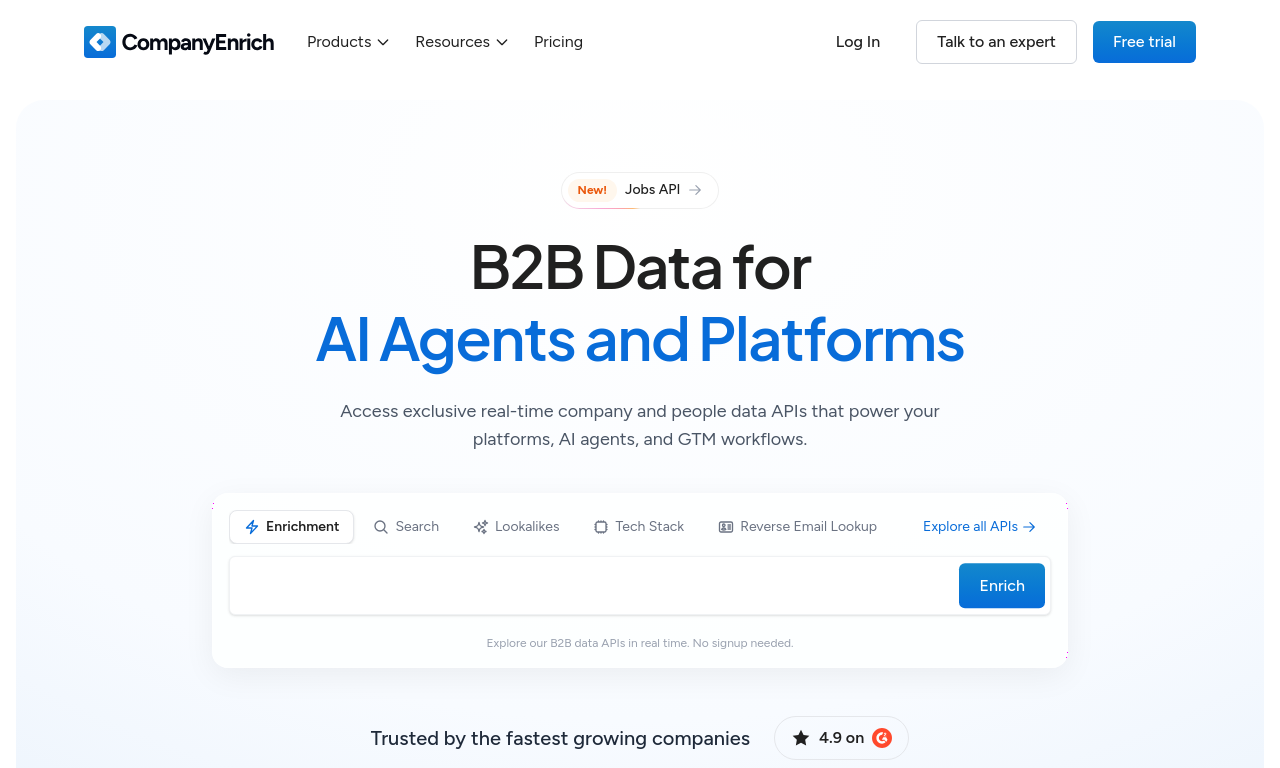
CompanyEnrich runs lookalike search through its Company Search API. You pass up to 10 seed domains, add any search filters, and receive ranked companies with full profiles, page by page. The same credit balance covers company enrichment, people search, and the rest of the API suite, so a lookalike list can flow straight into a search for the people at each account.
In the benchmark, CompanyEnrich had the highest relevance at both depths: 91.9% Precision@10 and 73.5% Precision@100, with an average response time of 1.3 seconds for up to 100 results.
What CompanyEnrich is good for
- Lists you use past the first page: relevance held at 73.5% across the first 100 positions, 10 points above the next provider. Cursor pagination continues beyond the first 100 results.
- Several seeds and filters in one request: combine up to 10 seed domains with country, employee, revenue, NAICS, technology, funding, and workforce-growth filters, and exclude domains you already have.
- Records you can use without a second call: each result is a full company profile with a ranking score. Optional expansions add technologies, keywords, financials, or workforce history.
- Agents and apps that wait for the answer: among providers returning 100 results, only Discolike averaged a faster response. The MCP server gives AI agents the same similar-company search.
Where CompanyEnrich may fall short
- Cost per result: lookalike search costs 5 credits per returned company, five times a standard search result. Per-search pricing from Extruct and Seltz, per-record pricing from Discolike, and ZoomInfo's free lookalike calls cost less per company. Each CompanyEnrich result is a full profile, so compare it with what enriching a cheaper list would cost.
- Combining seeds with a written description: a request can use seed domains or a natural-language query, not both. Narrow a lookalike search with filters, or run a semantic search separately.
- Individual weak seeds: its lowest scores came on Nubank (0% at both depths), Sea (30% Precision@10), and Caterpillar (12% Precision@100). Test the seeds your workflow depends on.
CompanyEnrich pricing
Monthly plans start at $49 for 5,000 credits, enough for 1,000 lookalike companies if the allowance goes entirely to lookalike search. The Scale plan lowers the credit price to $0.0011, about $0.0055 per lookalike company. A search that finds nothing costs one result's credits. The free trial includes 500 credits, or 100 lookalike companies.
When to choose CompanyEnrich
Choose CompanyEnrich when relevance has to hold across a long list, or when lookalikes run inside an automated workflow: CRM expansion, a recommendations panel in your product, or an agent that finds similar accounts and then the people who work there. Several seeds, filters, and full profiles keep that to one request per page.
2. PredictLeads
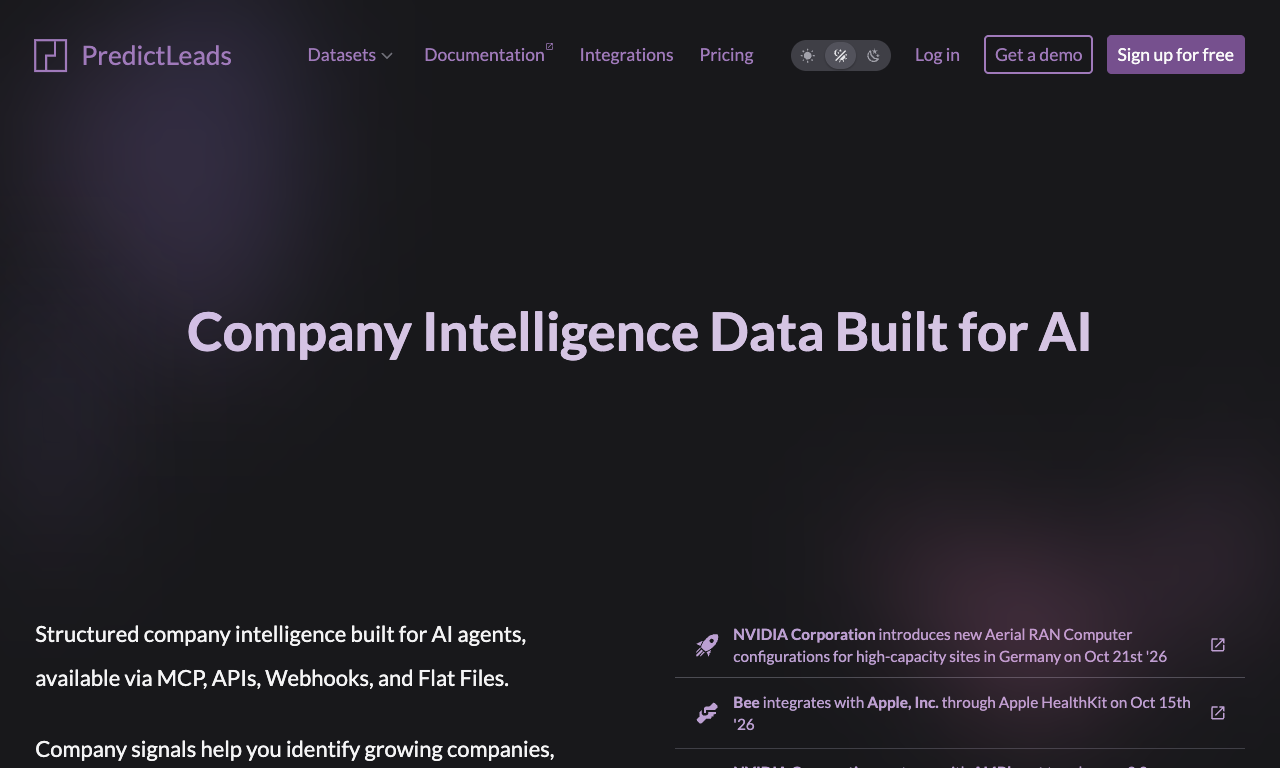
PredictLeads precomputes similar-company lists for more than 18.5 million companies. You pass one company ID or domain to its Similar Companies endpoint and receive the closest matches with a similarity score and list position. The top 20 also include a written reason for the match.
It scored 89.8% Precision@10 from 25 results per seed, second to CompanyEnrich, and returned 10 relevant companies out of 10 on 37 seeds, the most of any provider. It also returned no relevant top-10 results for Wise, Plaid, Motive, and project44.
What PredictLeads is good for
- Short lists people review: a score, a position, and a stated reason for the top 20 make each match easy to check.
- Fast lookups: it averaged 0.7 seconds per request in the benchmark.
- Low unit cost at volume: each returned company costs one credit, and the per-credit price falls with monthly volume.
Where PredictLeads may fall short
- Depth: the documented maximum is 50 similar companies per seed, so it suits shortlists rather than long account lists.
- No filters: the endpoint takes only page and limit. Filtering by country or size happens after retrieval, which shortens the list further.
- Thin records: results carry the domain, company name, and ticker. Firmographics need a separate company request.
- Customer-facing use: the public terms bar republishing or redistributing PredictLeads material. Confirm an agreement before showing results to your customers.
PredictLeads pricing
PredictLeads charges per returned company: requesting 10 similar companies uses 10 credits. The first 100 credits each month are free. Paid usage starts at $0.04 per credit with a $40 monthly minimum and falls to $0.002 per credit above 500,000 credits. Credits don't roll over.
When to choose PredictLeads
Choose PredictLeads for short, high-precision lists shown to a person or in an app, especially when an explanation of each match helps the reviewer.
3. Extruct
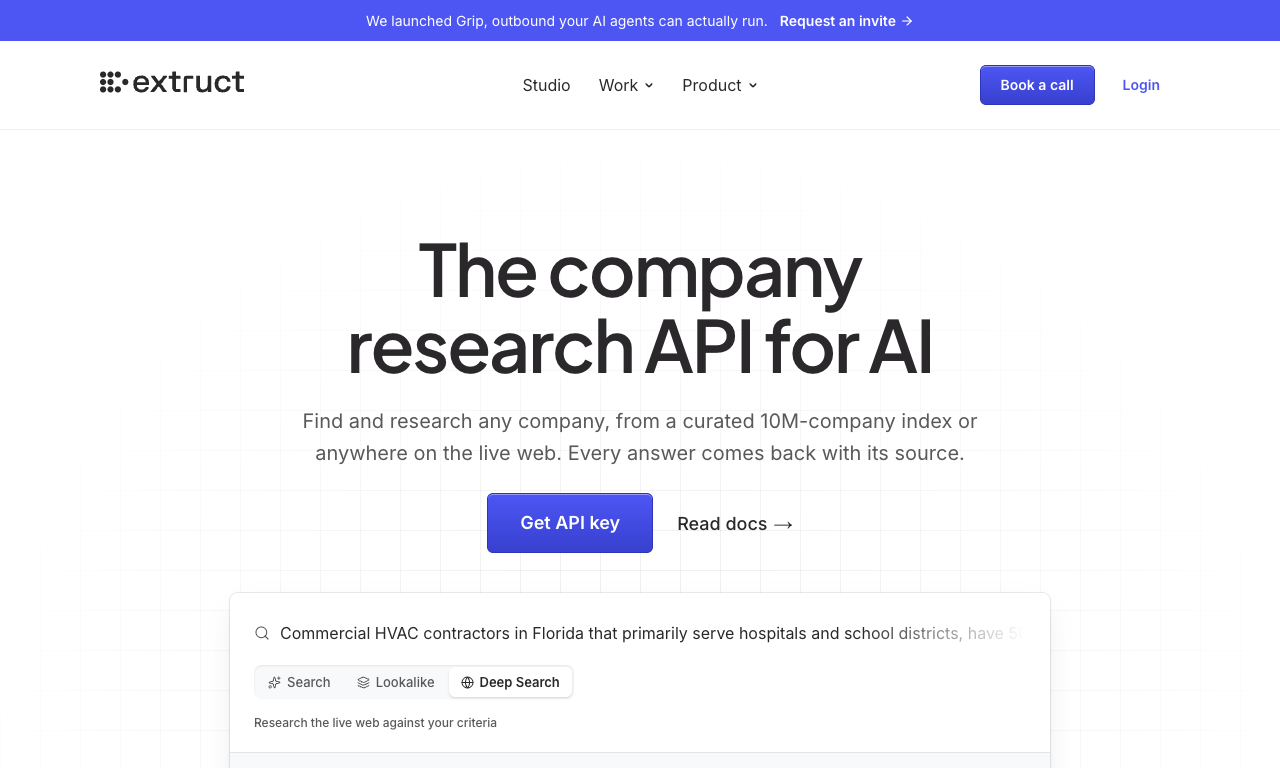
Extruct is an AI company search provider whose lookalike search takes one domain or Extruct ID per call. Results are text-rich profiles with descriptions, products and services, use cases, and target audience, which suits qualification by a language model.
It scored 75.0% Precision@10 and 61.1% Precision@100, third at the deeper cutoff, with a 2.4-second average response time.
What Extruct is good for
- Long lists at a low price: paid plans return up to 2,000 results per lookalike search, and one search costs one credit.
- Qualification by AI: product, use-case, and audience fields give a model enough context to classify each company.
- Large exclusions: exclude up to 1,000 domains and filter by employee size, headquarters country or city, and founding year.
Where Extruct may fall short
- Internal use only: Extruct's terms provide content "for your internal business or professional use only" and prohibit redistributing data in bulk. A customer-facing product needs separate permission.
- One seed per call: blending several customers into one profile means merging separate lists.
- Seed misses: it returned lists without relevant top-10 results for Plaid, Wise, Motive, and project44.
Extruct pricing
The free plan includes 25 lookalike searches a month with 25 results each. Starter costs $49 a month for 500 credits and Pro $149 for 2,000; each lookalike search uses one credit. Credits reset monthly.
When to choose Extruct
Choose Extruct for internal research and list building where depth and price per search matter more than license flexibility.
4. Ocean.io
Ocean.io's company search accepts up to 10 seed domains and combines them with one of the broadest filter sets in this guide: size, revenue, industries, locations, technologies, keywords, funding, web traffic, headcount growth, buying signals, and people filters. A request can return up to 10,000 companies.
It scored 74.3% Precision@10 and 59.5% Precision@100, averaging 2.4 seconds. It returned no relevant top-10 results for OpenAI, Plaid, Wise, and Motive, and nothing for Faire.
What Ocean.io is good for
- Filtered prospecting from several seeds: blend customer domains and narrow the list with firmographic and signal filters in the same request.
- Large pages: up to 10,000 results per request, with a cursor for more.
- Connected sales data: the same credit balance covers enrichment, people search, and contact reveals.
Where Ocean.io may fall short
- Ranking detail: relevance comes back as a letter grade (A, B, or C) rather than a numeric similarity score, which makes thresholds coarser.
- Seeds outside its index: domains Ocean.io doesn't know are returned as missing rather than matched.
- Volume on self-serve plans: default limits are 60 requests per minute and 1,000 per day.
- Use in your own product: its customer terms license the service for internal business purposes and prohibit resale or operating a service bureau.
Ocean.io pricing
Company search costs 0.2 credits per returned company, drawn from the same balance as enrichment and contact reveals. Plan allowances are on Ocean.io's pricing page.
When to choose Ocean.io
Choose Ocean.io for internal prospecting where lookalikes must meet detailed targeting rules and buying signals in a single request.
5. ZoomInfo
ZoomInfo offers Company Lookalikes through its GTM API, MCP server, and command-line tool. You pass a ZoomInfo company ID or a company name, which the service resolves to a best match, and receive up to 100 companies with a similarity score, rank, industry, revenue range, employee range, and country.
The benchmark seeded ZoomInfo by name through its CLI, which returned 25 results at the time; page size has since become configurable. It scored 67.1% Precision@10, averaged 1.2 seconds, and returned no relevant top-10 results for Mews, Wise, and Fluence. ZoomInfo's own CLI documentation calls name lookups less accurate than ID lookups.
What ZoomInfo is good for
- Teams already using ZoomInfo: lookalikes sit next to its contacts, intent, and company data.
- Free lookalike calls: Find Similar Companies uses no credits.
- Ranked output: each result has a 0 to 1 score and a rank.
Where ZoomInfo may fall short
- No domain input: you need a ZoomInfo ID or an exact company name.
- Coarse filters: four yes-or-no options restrict results to the seed's industry, country, revenue range, or employee range.
- Sparse results: the API response has no domain or description, so usable records often need paid enrichment.
- Use in your own product: ZoomInfo's license terms state that a licensee "shall not incorporate any portion of the Services or Licensed Materials into Licensee's own products or services."
ZoomInfo pricing
The lookalike call is free. Enriching a company record costs one data credit per new record. Self-serve accounts start with 1,000 data credits and 1,000 AI credits, with pay-as-you-go top-ups and custom enterprise pricing.
When to choose ZoomInfo
Choose ZoomInfo when your team already licenses its data and wants lookalikes for internal prospecting without another vendor.
6. Discolike
Discolike's Discover endpoint has the most flexible seeding in this guide. One request can combine up to 10 seed domains, up to 10 domains to push results away from, a written ICP description, and exact phrases to find on company websites. It returns up to 10,000 records per request, each with a similarity score.
It averaged 1.2 seconds, the fastest among providers tested at 100 results, but had the lowest long-list relevance: 41.9% Precision@10 and 34.6% Precision@100. It returned no relevant top-10 results for seven seeds, including OpenAI, HubSpot, and Plaid.
What Discolike is good for
- Iterating on an ICP: negative seeds and ICP text let you steer the list away from near misses.
- Local and regional lists: geographic filters include radius and bounding-box searches.
- Large pages: up to 10,000 records per request, and re-pulling a record within 90 days is free.
Where Discolike may fall short
- Relevance at depth: about a third of the first 100 positions were judged relevant in the benchmark.
- Size signals: employee counts are buckets, and the documentation describes its footprint score as "not a verified measure of company size or buying power."
- Customer-facing use: embedding data in a customer-facing product requires the Enterprise plan.
Discolike pricing
Plans start at $99 a month ($79 billed annually) and convert to credits. Each search has a query fee of $0.18 down to $0.08 by plan, plus $3.50 down to $1.50 per 1,000 new records. There is no free trial.
When to choose Discolike
Consider Discolike for internal experiments that mix seeds, negative examples, and ICP text, or for geographically bounded lists. Review relevance closely before using deep lists.
7. CUFinder
CUFinder's company lookalikes endpoint accepts a domain, company name, or LinkedIn URL and returns profiles with industry, size, location, revenue, funding, technologies, and contact fields such as emails and phone numbers.
It scored 38.9% Precision@10 from 10 results per seed, the lowest in the benchmark, with the fastest average response at 0.4 seconds.
What CUFinder is good for
- Starting from any identifier: a name or LinkedIn URL works when you don't have a clean domain.
- Contacts in the same response: returned profiles include public emails and phone numbers.
Where CUFinder may fall short
- Relevance: under four in ten of its top results were judged relevant.
- Control: one seed per call, no filters, no documented pagination, and no per-company similarity score.
- Use in your own product: its terms prohibit distributing or creating derivative products from its output without permission.
CUFinder pricing
The API reference lists 3 credits per lookalike request. Plans range from a free tier with 50 credits a month to $449 a month for 20,000 credits.
When to choose CUFinder
Consider CUFinder for occasional lookups when you start from a name or LinkedIn URL and want contact details in the same response.
Can You Use Exa, Parallel, or Seltz to Find Similar Companies?
Exa, Parallel, and Seltz are web search APIs built for AI agents. Each has a company search mode, and Openbenchmarks tested them alongside the lookalike APIs. Their top results were strong: Seltz reached 84.4% Precision@10 and Exa 80.8%.
The difference is the input. Their company modes take a written description of the companies you want, not a seed domain. The benchmark wrote a query for every seed, such as "Find companies similar to HubSpot (hubspot.com), the CRM and marketing automation platform. Return companies a buyer would realistically evaluate alongside HubSpot." That query becomes part of the result: describe the company differently and the list changes. Exa's older findSimilar endpoint accepts a URL, but Exa has deprecated it in favor of descriptive queries.
For an agent or a pipeline, that difference shows up in four places:
- Speed. The three web search APIs averaged 2.7 to 4.8 seconds per request for up to 100 companies; CompanyEnrich averaged 1.3 seconds. Those timings start from a finished query. In production, a person or a model first researches the seed and writes the description, which adds another model call before every search.
- Tokens and steps. A lookalike API takes the domain your CRM or agent already has. With a web search API, the agent spends tokens writing each query, and often more checking or enriching the results. Parallel's Entity Search returns a name, URL, and description per company, so firmographic fields need another call.
- Depth. Relevance fell further past the top 10: Exa dropped to 48.6% at 100 results, Parallel to 56.9%, and Seltz to 63.4%.
- Filters. Location, size, and industry go into the query text instead of structured filters, so you can't guarantee that every result is, for example, in Germany with 50 to 200 employees.
Per request, the web search APIs are inexpensive. Parallel lists Entity Search at $5 per 1,000 requests with 100 results included, Seltz charges $3 to $5 per 1,000 searches however many results come back, and Exa charges a base price per request plus $1 per 1,000 results above 10. Add the model calls for writing queries and the enrichment calls for missing fields before comparing.
Use web search APIs when you have no seed company: a market described in words, or a one-off research task for an agent. For repeated expansion from accounts you already know, a domain-based lookalike API removes the query-writing step and gives you filters and structured records.
How Much Do Lookalike Company APIs Cost?
Compare what each relevant company costs, not the advertised price per call. Pricing models differ enough that the cheapest call can produce the most expensive accepted account.
| Provider | What you pay for | List price | What changes the cost |
|---|---|---|---|
| CompanyEnrich | Each returned company | 5 credits ($0.0055 to $0.049 by plan) | Plan tier and optional expansions |
| PredictLeads | Each returned company | 1 credit ($0.002 to $0.04 by volume) | Monthly volume; firmographics cost extra requests |
| Extruct | Each lookalike search | 1 credit (Starter: $49 for 500) | Results per search, up to 2,000 on paid plans |
| Ocean.io | Each returned company | 0.2 credits | Plan allowance shared with contact reveals |
| ZoomInfo | Nothing for the lookalike call | Free | Data credits to enrich the records you keep |
| Discolike | Each search plus new records | $0.08 to $0.18 per query, plus $1.50 to $3.50 per 1,000 records | Plan tier; repeat pulls within 90 days are free |
| CUFinder | Each request | 3 credits | Plan tier |
Prices come from provider documentation and pricing pages checked on October 28, 2026.
A useful calculation is:
Cost per accepted company =
(lookalike calls + enrichment for missing fields + review time)
/ companies that meet your acceptance rules
For a hypothetical example, suppose a provider returns 100 companies for $1 and your review accepts 40. Each accepted company costs $0.025 before review time, and someone still had to reject the other 60. A provider that charges $3 for 100 results, 75 of them accepted, costs $0.04 per accepted company with far less review work. Run the numbers at the depth and plan tier you'll actually use.
How Should You Test a Lookalike Company API?
A small evaluation is useful when it mirrors the workflow you are building. I would follow these steps before committing to a provider.
1. Write the relevance rule first
Decide what makes a returned company useful before you look at any results. The benchmark's rule is a good template: same kind of business, same kind of buyer, and at least one shared product or service capability. Then decide whether adjacent companies, resellers, or subsidiaries count.
2. Choose seeds that represent your accounts
Use your real customers or target accounts, including the hard ones. Several providers in the benchmark missed Wise, Plaid, and Motive entirely, so include common-word names, country-code domains, rebranded companies, and diversified groups.
3. Score the depth you will use
If your app shows ten similar companies, judge the top ten. If a sequence will consume 200 accounts, judge 200. Count empty positions as misses; a short list that looks precise may simply be incomplete.
4. Apply your production filters
Run the same country, size, and industry filters and exclusion lists you will use in production. A provider without filters may look strong on raw lists and lose most of its results once you apply your rules.
5. Time the complete call path
For agents and in-app lookups, measure response time from your own environment, including any step that writes a query or enriches the results. Averages hide slow requests, so check the slowest ones too.
6. Confirm the license for your use
If customers will see, export, or store the companies, confirm that the agreement covers it. Several providers in this guide limit their standard terms to internal use. Do this for every provider, including CompanyEnrich, and compare quotes for the same use.
7. Connect accounts to people
A list of companies is rarely the final output. Plan how you'll find the right people at each accepted account, and test that step together with the lookalike search.
Which Lookalike Company API Should You Start With?
For lists you'll use beyond the first page, or for lookalikes inside an automated workflow, start with CompanyEnrich. It led both depths in the benchmark, accepts up to 10 seeds with filters, and returns full profiles in about a second. Its People Search API covers 204M+ professional profiles on the same credits, so the next step, finding the people, uses the same integration.
PredictLeads is the strongest choice for a short, explainable shortlist. Extruct gives long internal research lists at a low price per search, Ocean.io suits filtered internal prospecting with buying signals, and ZoomInfo makes sense when you already license its data. Discolike's seeding options and CUFinder's flexible inputs fit narrower jobs if you check relevance closely.
Whichever you shortlist, run your own seeds at the depth you need. You can try CompanyEnrich lookalike search with 500 free trial credits.
Frequently Asked Questions About Lookalike Company APIs
What are the best lookalike company APIs in 2026?
This guide compares CompanyEnrich, PredictLeads, Extruct, Ocean.io, ZoomInfo, Discolike, and CUFinder. In the October 2026 Openbenchmarks update, CompanyEnrich had the highest relevance for both the first 10 and the first 100 results, and PredictLeads ranked second at 10. The best fit still depends on list depth, seed input, filters, and license terms.
How does a lookalike company API work?
You send one or more seed companies, usually as domains. The API compares them with companies in its database using signals such as what each business sells, who it serves, its industry, and its size, then returns a ranked list. Many lookalike company APIs also return a similarity score and accept filters to narrow the results.
Can I use several seed companies in one request?
Some APIs accept several seeds. CompanyEnrich, Ocean.io, and Discolike take up to 10 seed domains in one request. PredictLeads, Extruct, ZoomInfo, and CUFinder take one seed per call, so you would merge and deduplicate separate lists.
How many similar companies can a lookalike API return?
It ranges from dozens to thousands. PredictLeads documents up to 50 per seed and ZoomInfo up to 100. CompanyEnrich returns 100 per page with cursor pagination, Extruct up to 2,000 per search on paid plans, and Ocean.io and Discolike up to 10,000 per request. Relevance usually falls with depth, so check quality at the depth you will use.
Can web search APIs like Exa find similar companies?
Exa, Parallel, and Seltz have company search modes that take a written description instead of a seed domain. In the benchmark they scored 69.2% to 84.4% on their first 10 results and less at 100, with average response times of 2.7 to 4.8 seconds. They suit research without a seed company; domain-based lookalike APIs suit repeated expansion from accounts you know.
How is lookalike API accuracy measured?
A common measure is Precision@K: the share of the first K results judged relevant to the seed. Openbenchmarks reports Precision@10 and Precision@100, judged by a panel of three AI models against a rubric that requires the same kind of business, the same kind of buyer, and a shared capability.
Is there a free lookalike company API?
ZoomInfo's lookalike calls use no credits, although enriching the results does. Extruct's free plan includes 25 lookalike searches a month, PredictLeads includes 100 free credits a month, and CompanyEnrich's free trial includes 500 credits, enough for 100 lookalike companies.
Can I find people at lookalike companies?
Yes. Pass the accepted domains to a people search API with title, seniority, or department filters. CompanyEnrich's People Search API searches 204M+ professional profiles on the same credits as lookalike search, so one integration takes you from a seed account to similar companies to the people you need.

Written by Amir, co-founder and CEO of CompanyEnrich. He has 10+ years of experience in B2B SaaS and data infrastructure, and previously founded and exited two B2B SaaS startups before starting CompanyEnrich. He now helps enterprises and startups integrate B2B intelligence into AI agents, workflows, and GTM operations.
Connect on LinkedIn